
Comments by Fed officials and the release of the minutes of the October FOMC meeting have convinced observers that the Fed will be raising its target for the federal funds rate as a step toward bringing inflation down to the 2 percent target. Market participants have priced in a 25-basis-point-hike at the next FOMC meeting on December 8 and 9. Moreover, market participants have priced in two additional hikes by mid-2027. Will this be sufficient?
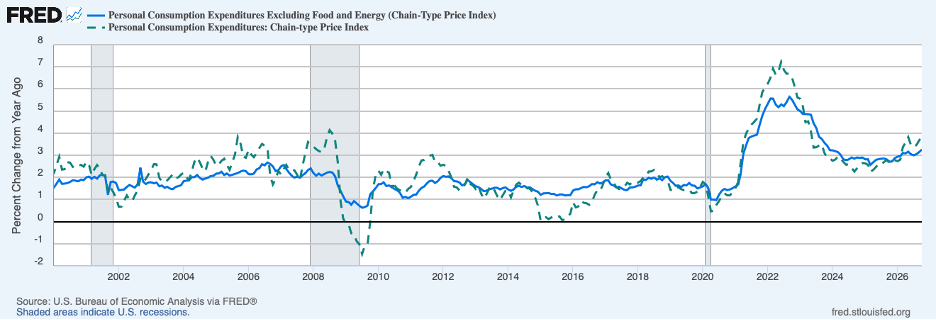
A key to answering this question relates to the trend in underlying inflation. The next chart illustrates that both headline and core PCE inflation, measured on a twelve-month percent change basis, turned up in October. Core inflation (the solid blue line) rose to 3.3 percent from 3.1 percent in September and 2.7 percent a year earlier.
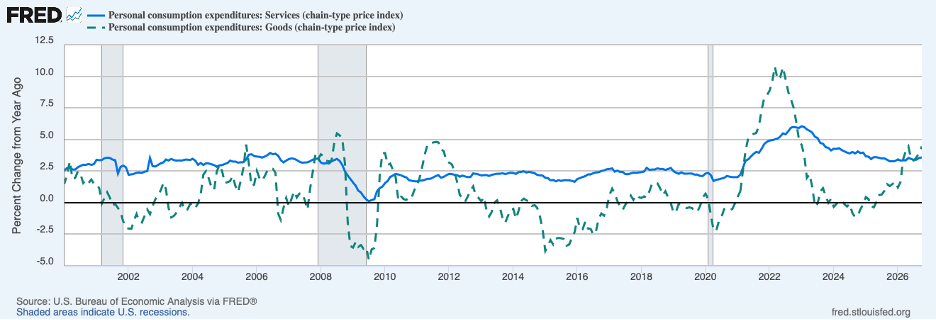
The goods component of both headline and core inflation has been buffeted by tariff shocks. In addition, the goods component of headline inflation has been buffeted by energy price shocks. In these circumstances, service prices give a better reading of underlying inflation. The chart below shows that the twelve-month percent change in service prices (the solid blue line) edged higher to 3.6 percent in October, up from 3.5 percent in September and 3.3 percent a year earlier. Recent service price inflation has exceeded average service price inflation over the decade prior to COVID by more than a full percentage point (roughly 3-1/2 percent over recent months compared to 2-1/4 percent in the previous decade).
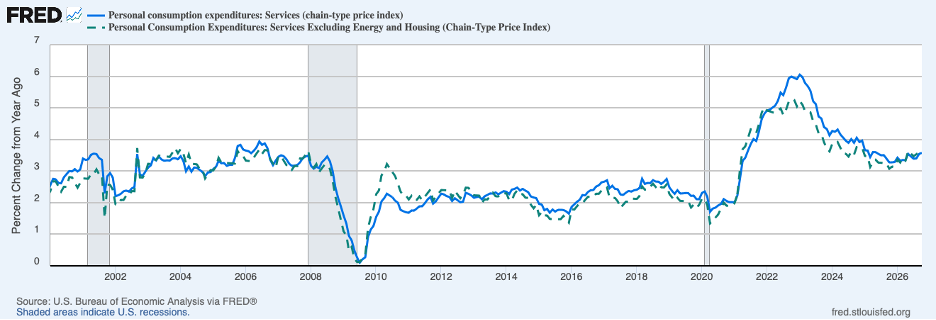
A similar story is told by service prices excluding housing and energy, as shown by the broken green line in the next chart. Some favor this measure of service prices as an indicator of underlying inflation in part because it is not affected by fluctuations in energy service prices, but also because it is not affected by housing costs which have been subject to unusual influences in recent years owing partly to the surge followed by a sharp slowdown in immigration. Service prices excluding housing and energy rose 3.7 percent over the twelve months ending in October compared with 3.6 percent in September and 3.1 percent a year earlier. Recent increases in these service prices have surpassed those for the decade prior to the pandemic by the same margin as prices of all services.
Not only is stubborn inflation pointing to a stance of monetary policy that is highly accommodative, but the economy is growing at an unsustainable pace. Growth in real GDP in the third quarter was at a brisk 4.3 percent annual rate and growth in private domestic final purchases — business and consumer demand — soared to a 5.8 percent annual rate from a hefty 3.0 percent rate over the first half of the year. Moreover, early indications are that the fourth quarter will be another notable quarter with GDP growing at around 3 percent (Source: FRB Atlanta, GDPNow, and FRB New York, Nowcast).
The real federal funds rate is only 0.6 percent (chart below) when measured by subtracting the twelve-month percent change in core PCE prices from the effective nominal federal funds rate.
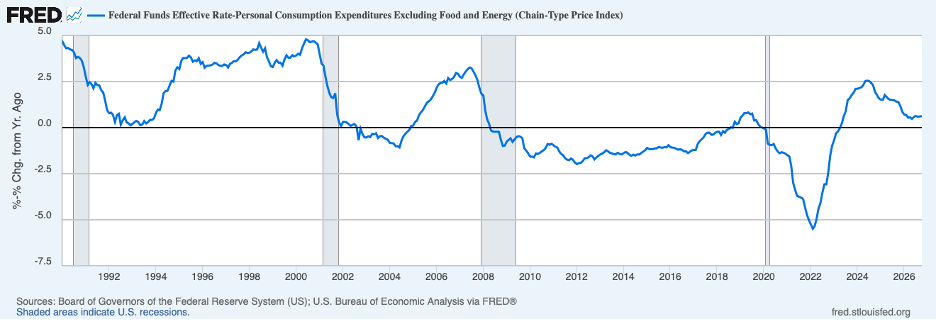
This level of the real funds rate is at least one percentage point below the neutral rate, the rate at which monetary policy is neither accommodative nor restrictive. (The real federal funds rate averaged 2-3/4 percent over the 1990s — a period that has similarities to the current period; real GDP grew at a 3.4 percent annual rate over the 1990s.) In other words, the federal funds rate will need to be raised at least 100 basis points just to remove the stimulus coming from monetary policy.
However, raising the federal funds rate by 100 basis points is unlikely to be enough to place underlying inflation on a downward trajectory to the 2 percent target. Current inflation has enough momentum that a sizable dose of monetary medicine will be needed to bring inflation under control — perhaps on the order of another 150 basis points or even more. The full extent of the process that leads to such inflation momentum is not fully understood by the economics profession, but research shows that the momentum is there. Tightening delays in the past and preemptive easing of policy in response to the possibility of a softer labor market have contributed to this momentum.
Wishful thinking that the target for inflation can be achieved with only a moderate amount of further tightening will not get the job done. Delaying aggressive tightening runs the risk of inflation becoming even more deeply embedded and necessitating even more monetary stringency and dislocation to the economy (output and employment) to achieve disinflation. The drop in the stock market and heightened volatility of share prices may reduce the extent of tightening required to restore price stability, but, even then, the Fed has a formidable job ahead. At the end of the day, the Fed will not succeed in achieving maximum sustainable employment until it has achieved its price stability goal.
Featured Image: David Vives / Unsplash


