Jerome Powell took the helm of the Federal Reserve in February 2018, being elevated to that position from that of a regular member of the Board. He was replaced as chair in May 2026, returning to his seat as a regular governor. Mr. Powell was chosen to be chair of the Board of Governors by President Trump who also chose to replace him eight years later amid a firestorm of criticism of Powell’s leadership.
Chair Powell’s tenure can be thought of as having two distinct periods: the first being from February 2018 to the start of 2021 and the second being from the start of 2021 to the end of his term in May 2026. The chart below shows that the first period was characterized by subdued inflation (1.6 percent average annual increase in core PCE inflation) in contrast to an inflation roller coaster in the second (3.6 percent annual average increase in core PCE). Moreover, the chart shows that inflation had turned up over the final months of Chair Powell’s term.

The important external event separating these two periods was the 2020 COVID-19 shock which pushed the economy into an abrupt but brief recession (the shaded area in the chart above). In response, the federal government enacted massive fiscal stimulus programs and the Fed pulled out all the monetary stops. The Fed immediately slashed the federal funds rate to 0 to 25 basis points and embarked on huge asset purchases on a scale reminiscent of the Financial Crisis (2008 and 2009) and its aftermath. As a consequence, aggregate demand soared. The COVID shock also caused numerous supply-chain disruptions around the globe that curtailed the aggregate supply of goods. By early 2021, the resulting inflationary pressures were unfolding in a big way.
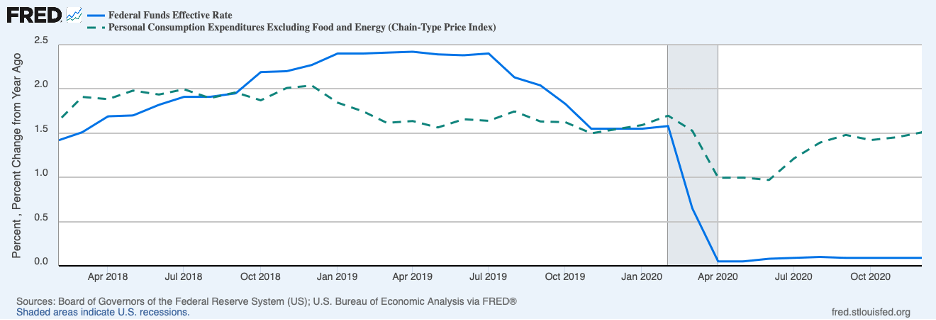
The next chart shows core inflation and the Fed’s policy interest rate (the federal funds rate) over the first period of Chair Powell’s tenure. The solid blue line in the chart shows that the Fed was raising the federal funds rate during 2018 despite inflation running below or near its 2 percent target. The labor market was strong, and it was thought that the level of the federal funds rate was unsustainably low — that is, below the neutral rate (the interest rate at which monetary policy is neither stimulative nor restrictive). Keeping the federal funds below the neutral rate would lead to a build-up of inflationary pressures. Note that core inflation — the broken green line — moderated after the Fed started tightening and remained below the 2 percent target.
In the period leading up to 2020, the Fed had routinely overpredicted core PCE inflation, as shown in the table below. In five of the seven years shown below, the Fed’s median year-ahead forecast made in December was higher than the inflation that materialized for each year — in 2015 and 2019 by sizable amounts. The experience of this episode in Chair Powell’s tenure suggests that, despite appreciable monetary stimulus and fiscal policy that was moving from restraint to stimulus, inflation remained stubbornly low. There was a surprising persistence factor in the inflation process.
Core PCE Inflation
Actual and FOMC Median Year-ahead Forecast
(in percent)
| Year | Actual | Year-ahead Forecast |
| 2013 | 1.5 | 1.7 |
| 2014 | 1.4 | 1.5 |
| 2015 | 1.2 | 1.7 |
| 2016 | 1.8 | 1.6 |
| 2017 | 1.6 | 1.8 |
| 2018 | 2.0 | 1.9 |
| 2019 | 1.6 | 2.0 |
The low inflation was causing problems for the Fed. Below-target inflation was raising concerns that persistent low inflation might cause inflation expectations to drift lower; this would cause inflation to decline even further and add to the Fed’s difficulties in bringing inflation back to 2 percent. Moreover, low inflation might damage the Fed’s credibility as Fed officials were frequently affirming their commitment to achieve the 2 percent inflation target. Furthermore, low inflation, along with some evidence that the neutral federal funds rate had fallen, was causing the level of interest rates to be lower and closer to zero — the so-called effective lower bound. Rates closer to zero meant that the Fed had less scope to lower the federal funds rate in response to a negative shock to the economy.
In response to persistently low inflation, the Fed in August 2020 adopted a new approach to pursuing the dual mandate which came to be known as flexible average inflation targeting. Regarding the maximum employment mandate, the Fed would consider shortfalls from maximum employment rather than deviations from maximum employment in making monetary policy decisions. In other words, the Fed was going to approach departures from maximum employment in an asymmetric way, focusing on shortfalls and deemphasizing overshoots.
Turning to the stable prices mandate, the Fed would be focusing on average inflation in a flexible way (not over a fixed time interval). In the words of Chair Powell (italics mine):
“To prevent this outcome (author’s note: businesses and households revising lower their expectations of future inflation in response to persistent below-target inflation) and the adverse dynamics that could ensue, our new statement indicates that we will seek to achieve inflation that averages 2 percent over time. Therefore, following periods when inflation has been running below 2 percent, appropriate monetary policy will likely aim to achieve inflation moderately above 2 percent for some time.”
In other words, to better ensure that expectations of inflation do not drift lower, the Fed would tolerate “moderate” overshoots for “some time.” The Fed would be looking at average inflation over time in its effort to ensure that inflation expectations were anchored around 2 percent.
What followed several months later was a burst in inflation, as shown by the dotted green line in the chart below, extending well above the 2 percent target. The combination of soaring aggregate demand and restraints on aggregate supply were leading to levels of inflation last seen during the Great Inflation of the late 1970s and early 1980s. Parsing out the contribution of policy stimulus effects as distinct from supply-chain effects proved difficult. Chair Powell and other Fed officials tended to focus on supply side, one-off causes and referred to the burst in inflation as “transitory” (a term that was quietly retired as inflation persisted). Accompanying this interpretation was a protracted delay in tightening policy. As the blue line in the chart below shows, it was not until March 2022, when the upturn in inflation had been well underway, that the Powell Fed started liftoff from a highly stimulative policy position. At this point, underlying inflation had developed some momentum. The persistence factor had returned. However, this time the persistence factor was contributing to higher inflation.

Fed officials continued to underpredict inflation, as shown in the table below. In only one of the five years shown did the FOMC overpredict inflation and in each of the other years the underprediction was substantial (an average of 1.6 percentage points). And it is likely that the prediction of PCE core inflation for 2026 made in December 2025 of 2.5 percent will turn out to be another appreciable underprediction, as core PCE prices rose through May 2026 at a 4.0 percent annual rate.
Core PCE Inflation
Actual and FOMC Median Year-ahead Forecast
(in percent)
| Year | Actual | Year-ahead Forecast |
| 2021 | 4.8 | 1.8 |
| 2022 | 5.2 | 2.7 |
| 2023 | 3.3 | 3.5 |
| 2024 | 3.0 | 2.4 |
| 2025 | 2.9 | 2.5 |
The period from the start of 2020 has experienced some notable supply shocks — COVID and the accompanying supply-chain disruptions in 2020 and 2021, the Russian attack on Ukraine in 2022, large hikes in tariffs in 2025, and the Iran conflict in 2026 — all of which boosted consumer prices. (The Russian and Iranian raised headline inflation in relation to core inflation by pushing up energy prices while supply-chain and tariff disturbances pushed up prices of other goods.) The Fed, like outside observers, tried to separate inflation caused by supply shocks from that caused by stimulative monetary policy. In practice, the Fed has attributed a lot of the cause of high inflation to an unfortunate series of supply shocks. (A 2025 study of underpredictions of inflation in forecasts prepared for FOMC members before each meeting by staff at the Board pointed to numerous special factors accounting for their forecast misses. These included the above supply shocks and an unexplained upward shift in the relationship between inflation and unemployment — the Phillips curve. Missing was a recognition of the momentum or persistence factor that characterizes the inflation process once higher inflation takes hold.
See Peneva, Ekaterina, Jeremy Rudd, and Daniel Villar, “Retrospective on the Federal Reserve Board Staff’s Inflation Forecast Errors since 2019,” Finance and Economics Discussion Series, 2025-069.)
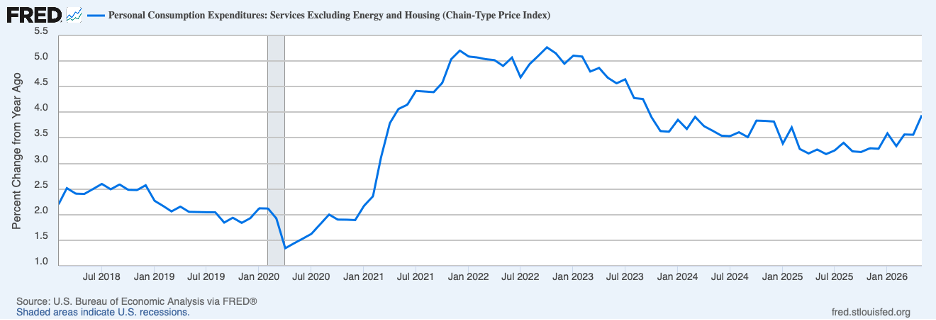
The top chart below presents inflation in service prices excluding energy and housing. This measure of inflation likely is a good measure of underlying inflation over recent years and is not as vulnerable to the special factors mentioned above (it removes the housing cost component of the index which many observers thought was not capturing actual housing costs facing consumers during much of this time). This service-price measure rose markedly in 2021 from the vicinity of 2 percent to reach 5 percent in 2022 and 2023 but has since moved down to the 3-1/2 percent area (most recently it has been edging above 3-1/2 percent).
The bottom chart below shows an estimate of the real federal funds rate derived by subtracting the twelve-month percent change in core PCE from the effective federal funds rate. The position of the real federal funds rate in relation to the real neutral federal funds rate (which cannot be observed directly) is an indicator of the stance of monetary policy, whether it is stimulative or restrictive and the degree to which it is stimulative or restrictive.
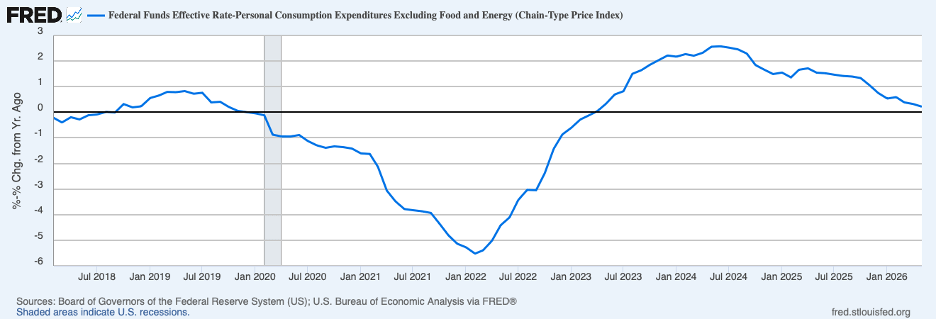
The real federal funds rate was deeply negative and thus highly stimulative when the Fed started to raise the federal funds rate in March 2022. The Fed stopped raising the nominal federal funds rate in mid-2023 as the real funds rate was moving into the 2 percent region. This stance of policy ultimately became somewhat restrictive and proved somewhat successful in putting downward pressure on underlying inflation. (Note that the real federal funds rate continued to increase after the Fed stopped tightening in mid-2023 owing to receding underlying inflation.)
In retrospect, policy was not as restrictive as Chair Powell and other FOMC members thought. In their projections, published four times each year, the median implied neutral rate that they were using in assessing their policy stance was only ½ percent through 2023. It was then revised upward to 1 percent over the course of 2024 (in June 2026, the median neutral rate was revised upward again but only to 1.1 percent). Even at 1 percent, the neutral rate used by FOMC members was quite low based on a longer sweep of history and the slow-moving fundamentals that drive the neutral rate. Using such low values of the neutral rate in assessing the stance of policy resulted in the view among Fed officials that policy was placing more restraint on inflation than it was in reality.
Chair Powell in August 2022 seemed to realize that it could take some time before price stability would be restored, and that the Fed must stick with the job of bringing inflation lower. In the words of Chair Powell during a speech given at the annual FRB Kansas City Jackson Hole conference:
(Author’s note: first lesson was that the job of price stability was the Fed’s and the second lesson was that expectations of inflation play an important in the inflation process).
“That brings me to the third lesson, which is that we must keep at it until the job is done. History shows that the employment costs of bringing down inflation are likely to increase with delay, as high inflation becomes more entrenched in wage and price setting. The successful Volcker disinflation in the early 1980s followed multiple failed attempts to lower inflation over the previous 15 years. A lengthy period of very restrictive monetary policy was ultimately needed to stem the high inflation and start the process of getting inflation down to the low and stable levels that were the norm until the spring of last year. Our aim is to avoid that outcome by acting with resolve now.”
This statement would seem to suggest that Chair Powell was alluding to the persistence factor in the inflation process. Indeed, elsewhere in this speech, Chair Powell referred to a statement by a predecessor, Paul Volcker, about inflation, once it is underway, feeding on itself.
However, two years later, on August 23, 2024, at the annual FRB Kansas City Jackson Hole Conference, Chair Powell signaled that the Fed would begin easing policy in response to growing concerns about a weakening labor market. In his statement, he said (italics mine):
“Overall, the economy continues to grow at a solid pace. But the inflation and labor market data show an evolving situation. The upside risks to inflation have diminished. And the downside risks to employment have increased. As we highlighted in our last FOMC statement, we are attentive to the risks to both sides of our dual mandate.
The time has come for policy to adjust. The direction of travel is clear, and the timing and pace of rate cuts will depend on incoming data, the evolving outlook, and the balance of risks.
We will do everything we can to support a strong labor market as we make further progress toward price stability. With an appropriate dialing back of policy restraint, there is good reason to think that the economy will get back to 2 percent inflation while maintaining a strong labor market.”
At the time of this speech, core PCE inflation and PCE service prices excluding housing and energy inflation were leveling off at a rate that was one percentage point or more above the inflation rate before the pandemic. The priority of monetary policy evidently had shifted from doing what was necessary to restore price stability to worries about the labor market in this two-year stretch.
Less than a month later, the FOMC dramatically lowered its policy interest rate 50 basis points, not the 25 basis points expected in financial markets. Moreover, by the end of 2024, the FOMC had lowered the policy rate a full percentage point (followed by further rate cuts of 75 basis points over the latter part of 2025). As an indication that these easing measures were subsequently seen as premature, the yield on the key ten-year Treasury note ended the 2024-year 60 basis points above its level on the eve of Chair Powell’s August speech.
The framework widely used in the economics profession for understanding the relationship between lasting high levels of employment and achievement of the inflation target tell us that actual inflation must be near the expected rate of inflation and also near the central bank’s inflation target for sustainable maximum employment. In other words, the dual mandate is achieved when actual inflation is brought in line with the central bank’s target and the public’s expectations of inflation match that target. This is the lesson of the Volcker victory over the Great Inflation and the long period of very good macroeconomic performance known as the Great Moderation that followed. (The FOMC’s, “Statement of Longer-Run Goals and Monetary Policy Strategy,” that is issued in January of each year appears to rely on the framework mentioned above.)
In retrospect, it is now quite clear that the Powell Fed began easing policy too soon. By relying on a notion of the neutral federal funds rate that was too low, the FOMC mis-calibrated the degree of monetary restraint that they had put in place. Moreover, they were relying on lags in the effects of that perceived restraint to place underlying inflation on a steady downward path to price stability. The Powell Fed did not stick with the job of bringing inflation lower at a time when high inflation had become entrenched in wage and price setting.
On a more favorable note, Chair Powell and other Federal Reserve officials frequently affirmed publicly their commitment to restoring price stability which undoubtedly helped contain inflation expectations and limit any further upward drift in actual inflation. The chart below shows one measure of longer-term inflation expectations derived from the market for nominal and inflation-protected securities.
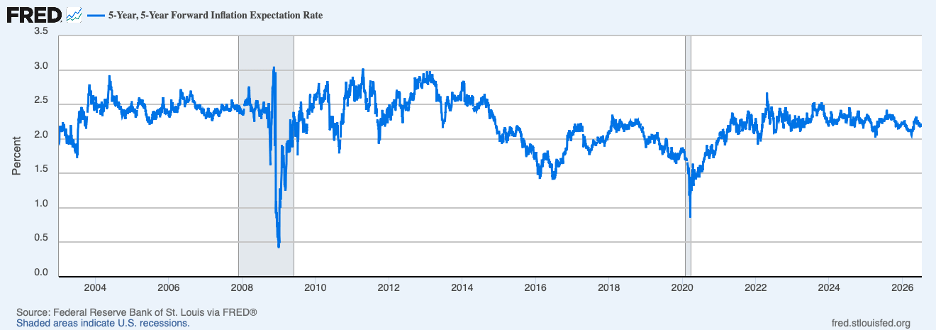
This market measure indicates that inflation expectations did not rise sharply as consumer prices accelerated in 2021 and beyond; indeed, inflation expectations were only a bit above where they had been prior to COVID (note that they have ticked down most recently following unequivocal statements by new Fed Chair Warsh that the Fed would get inflation back to the 2 percent target).
In addition, Chair Powell, in the final year of his tenure as chair, responded vigorously to protect the independence of the Fed when it was facing an unprecedented challenge. Any material loss of independence would have weakened the Fed’s credibility and its ability to achieve not only its price stability mandate but also its maximum sustainable employment mandate.
In sum, the Jerome Powell legacy has been stained by taking the eye off the inflation goal when a continuation of policy restraint was needed. If only he had continued to follow his wise words of August 2022. As a consequence, history may have yet another example of the mounting cost of delaying efforts to reach price stability.


